
Unpopular Opinion: Kiosk + Employee = Better CX
Do self-service kiosks hurt hospitality? Learn why kiosks + employees create a better quick service restaurant customer experience.
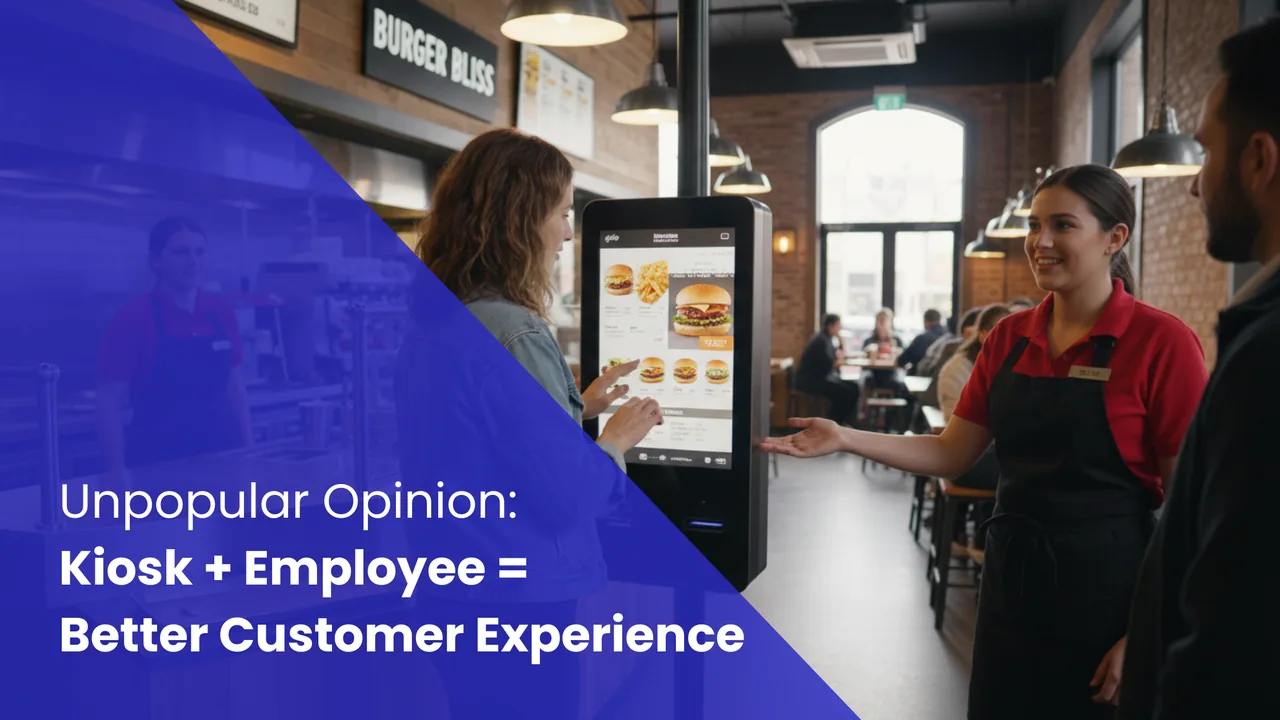
For years, the conversation around self-service kiosks has been framed as kiosks versus employees. Either you automate and lose the human touch, or you stay fully staffed and sacrifice speed. But that’s a false choice.
The reality? The best front of house customer experience happens when kiosks and employees work together.
In today’s quick service restaurant customer experience, speed, accuracy, and human connection all matter. Customers want options. They want control. And they want to feel seen—not rushed. A thoughtful combination of self-service kiosk technology and well-trained staff doesn’t replace hospitality; it elevates it.
Here’s why the unpopular opinion might actually be the smartest one.
1. Faster lines, shorter wait times, happier guests
Let’s start with the most obvious benefit: speed.
Not everyone wants to use a self-service kiosk—but many do. Especially repeat customers who already know what they want. When kiosks absorb a portion of ordering traffic, lines move faster for everyone. That means shorter wait times, less congestion at the counter, and fewer abandoned visits. According to QSR Magazine, kiosks significantly reduce perceived wait times and improve order accuracy in high-volume environments.
Your food may be incredible, but if customers see a long line stretching out the door, they might not stick around to find out. In quick service environments, convenience is part of the product. Research from PwC shows that speed and convenience are among the top drivers of customer loyalty in food service. Kiosks give guests a way to opt into speed without forcing it on those who prefer face-to-face interaction.
The result?
- Guests who value efficiency get in and out quickly
- Guests who want a human interaction still get it
- Your front of house customer experience feels calmer, not chaotic
Choice is the key. Kiosks don’t replace the counter—they relieve pressure from it.
2. Employees can focus on experience, not just taking orders
When employees are stuck in “order-taking mode” all day, the human element of hospitality gets lost. They’re rushing, multitasking, repeating the same questions, and trying to keep the line moving. That’s not connection—that’s survival.
Self-service kiosks change that dynamic. According to McKinsey, automation works best when it frees employees to focus on higher-value, customer-facing tasks rather than repetitive work.
By offloading routine orders to kiosks, employees are freed up to focus on what humans do best: engaging, guiding, and creating moments that reflect your brand. Instead of racing through transactions, staff can greet guests, answer questions, make recommendations, and solve problems in real time.
This is where training matters. When kiosks handle the mechanics, employees can be trained to:
- Welcome guests and explain the ordering options
- Assist first-time kiosk users without pressure
- Build rapport with dine-in customers
- Ensure orders are accurate and meals are delivered smoothly
The quick service restaurant customer experience improves not because there are fewer employees—but because employees are doing better work. They’re no longer just order takers; they’re brand ambassadors.
3. Let kiosks handle upsells—because they never forget (and never judge)
Upselling is important for revenue, but it’s awkward for humans. Employees forget. They feel uncomfortable pushing add-ons. And customers sometimes feel guilty saying no—especially when there’s a line behind them.
This is where self-service kiosks shine.
A kiosk will always remember to suggest an upsell. Extra cheese. A drink upgrade. A dessert add-on. And customers can take their time considering those options without feeling like they’re holding anyone up.
Even better? There’s no pressure.
No judgment.
No rushed decision-making.
Customers often order more at kiosks because they feel in control—and because the experience feels private and relaxed. Meanwhile, your employees don’t have to juggle speed, politeness, and sales goals all at once. Studies cited by Restaurant Business show that self-service kiosks consistently increase average check size by suggesting add-ons at the right moment.
It’s a win for everyone:
- Higher check averages
- Less stress for staff
- More comfortable ordering for guests
The future of front of house isn’t automated—it’s balanced
The best front of house customer experience isn’t about choosing technology or people. It’s about designing an environment where each plays to its strengths.
Self-service kiosks bring speed, consistency, and smart upselling.
Employees bring warmth, flexibility, and genuine hospitality.
Together, they create a quick service restaurant customer experience that feels modern, efficient, and human—all at the same time.
So yes, it may be an unpopular opinion. But in practice, kiosk + employee isn’t the problem—it’s the solution.
See what INFI can do for your restaurant
Add self-ordering, online ordering, loyalty, and marketing on top of the POS you already run.
Book a Demo