
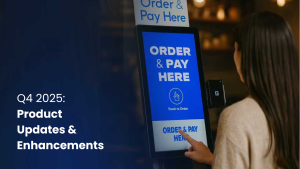


The quick-service restaurant (QSR) industry is evolving rapidly, driven by consumers’ increasing demands for speed, convenience, and personalization. In this fast-paced environment, self-service kiosks have emerged as a game-changer, revolutionizing the way QSRs operate and interact with their customers. Here are five compelling reasons why your QSR needs to embrace self-service kiosks in 2024:
Long lines can deter customers and hinder operational efficiency during peak hours. Self-service kiosks alleviate this bottleneck by allowing customers to browse the menu, customize their orders, and complete transactions independently. By reducing wait times and distributing the workload, kiosks free up staff to focus on other tasks, ultimately increasing overall efficiency and order throughput.
Example: Imagine a busy lunch hour at your QSR. Instead of waiting in a long line, customers can quickly place their orders and pay at self-service kiosks, enabling your staff to serve more customers in less time. This streamlined process not only enhances the dining experience but also maximizes revenue potential during peak periods.
Every customer has unique preferences and dietary requirements. Self-service kiosks empower customers to customize their orders according to their tastes, from selecting toppings to modifying ingredients. By offering a wide range of customization options, QSRs can cater to diverse customer needs, resulting in increased satisfaction and loyalty.
Example: A customer with dietary restrictions walks into your QSR. With self-service kiosks, they can easily customize their order to meet their specific dietary requirements, ensuring a positive dining experience. Additionally, visually appealing menu displays on the kiosk can entice customers to explore new menu items, driving up average order value.
Manual order taking can be prone to errors, leading to customer dissatisfaction and food waste. Self-service kiosks eliminate this risk by allowing customers to visually confirm their selections before finalizing their orders. This ensures accuracy, reduces mistakes, and enhances overall customer satisfaction.
Example: A customer selects their desired items on the self-service kiosk, reviewing each choice before submitting the order. This visual confirmation step minimizes the likelihood of errors, resulting in precise order fulfillment and happy customers who receive exactly what they ordered.
Self-service kiosks are not just a convenience; they symbolize innovation and cater to the tech-savvy preferences of modern consumers. By integrating this technology, QSRs demonstrate their commitment to providing a modern dining experience, attracting new customers and enhancing brand relevance in a competitive market.
Example: As customers walk by your QSR, they notice sleek, interactive self-service kiosks that offer a seamless ordering experience. Intrigued by the innovative technology, they decide to give your establishment a try, drawn in by the promise of a modern dining experience and personalized service.
Self-service kiosks serve as valuable data collection tools, capturing insights into customer preferences, popular menu items, and peak ordering times. This wealth of information enables QSRs to make informed decisions regarding menu optimization, staffing levels, and promotional strategies, driving growth and profitability.
Example: By analyzing data collected from self-service kiosks, your QSR identifies trends indicating increasing demand for plant-based menu options during certain times of the day. Armed with this information, you adjust your menu offerings and promotional campaigns accordingly, capitalizing on emerging trends and satisfying customer preferences.
Implementing self-service kiosks in your QSR isn’t just a trend—it’s a strategic investment in your future success. By offering speed, personalization, accuracy, and a modern dining experience, you can delight your customers, boost your bottom line, and stay ahead of the curve in the competitive QSR landscape.
Ready to learn more? Contact us today to discuss how our kiosks can transform your QSR and unlock your full potential!
INFI
We firmly believe that the internet should be available and accessible to anyone, and are committed to providing a website that is accessible to the widest possible audience, regardless of circumstance and ability.
To fulfill this, we aim to adhere as strictly as possible to the World Wide Web Consortium’s (W3C) Web Content Accessibility Guidelines 2.1 (WCAG 2.1) at the AA level. These guidelines explain how to make web content accessible to people with a wide array of disabilities. Complying with those guidelines helps us ensure that the website is accessible to all people: blind people, people with motor impairments, visual impairment, cognitive disabilities, and more.
This website utilizes various technologies that are meant to make it as accessible as possible at all times. We utilize an accessibility interface that allows persons with specific disabilities to adjust the website’s UI (user interface) and design it to their personal needs.
Additionally, the website utilizes an AI-based application that runs in the background and optimizes its accessibility level constantly. This application remediates the website’s HTML, adapts Its functionality and behavior for screen-readers used by the blind users, and for keyboard functions used by individuals with motor impairments.
If you’ve found a malfunction or have ideas for improvement, we’ll be happy to hear from you. You can reach out to the website’s operators by using the following email Marketing@INFI.us
Our website implements the ARIA attributes (Accessible Rich Internet Applications) technique, alongside various different behavioral changes, to ensure blind users visiting with screen-readers are able to read, comprehend, and enjoy the website’s functions. As soon as a user with a screen-reader enters your site, they immediately receive a prompt to enter the Screen-Reader Profile so they can browse and operate your site effectively. Here’s how our website covers some of the most important screen-reader requirements, alongside console screenshots of code examples:
Screen-reader optimization: we run a background process that learns the website’s components from top to bottom, to ensure ongoing compliance even when updating the website. In this process, we provide screen-readers with meaningful data using the ARIA set of attributes. For example, we provide accurate form labels; descriptions for actionable icons (social media icons, search icons, cart icons, etc.); validation guidance for form inputs; element roles such as buttons, menus, modal dialogues (popups), and others. Additionally, the background process scans all the website’s images and provides an accurate and meaningful image-object-recognition-based description as an ALT (alternate text) tag for images that are not described. It will also extract texts that are embedded within the image, using an OCR (optical character recognition) technology. To turn on screen-reader adjustments at any time, users need only to press the Alt+1 keyboard combination. Screen-reader users also get automatic announcements to turn the Screen-reader mode on as soon as they enter the website.
These adjustments are compatible with all popular screen readers, including JAWS and NVDA.
Keyboard navigation optimization: The background process also adjusts the website’s HTML, and adds various behaviors using JavaScript code to make the website operable by the keyboard. This includes the ability to navigate the website using the Tab and Shift+Tab keys, operate dropdowns with the arrow keys, close them with Esc, trigger buttons and links using the Enter key, navigate between radio and checkbox elements using the arrow keys, and fill them in with the Spacebar or Enter key.Additionally, keyboard users will find quick-navigation and content-skip menus, available at any time by clicking Alt+1, or as the first elements of the site while navigating with the keyboard. The background process also handles triggered popups by moving the keyboard focus towards them as soon as they appear, and not allow the focus drift outside it.
Users can also use shortcuts such as “M” (menus), “H” (headings), “F” (forms), “B” (buttons), and “G” (graphics) to jump to specific elements.
We aim to support the widest array of browsers and assistive technologies as possible, so our users can choose the best fitting tools for them, with as few limitations as possible. Therefore, we have worked very hard to be able to support all major systems that comprise over 95% of the user market share including Google Chrome, Mozilla Firefox, Apple Safari, Opera and Microsoft Edge, JAWS and NVDA (screen readers).
Despite our very best efforts to allow anybody to adjust the website to their needs. There may still be pages or sections that are not fully accessible, are in the process of becoming accessible, or are lacking an adequate technological solution to make them accessible. Still, we are continually improving our accessibility, adding, updating and improving its options and features, and developing and adopting new technologies. All this is meant to reach the optimal level of accessibility, following technological advancements. For any assistance, please reach out to Marketing@INFI.us
If you're unsure, please reach out to support@infi.us.

