
Restaurant SEO: The 2026 Guide to Winning Local Search
A plain-English restaurant SEO guide for independents: how to show up in “near me” searches and Google Maps with your Google Business Profile, reviews, a fast indexable site and local content — in priority order.
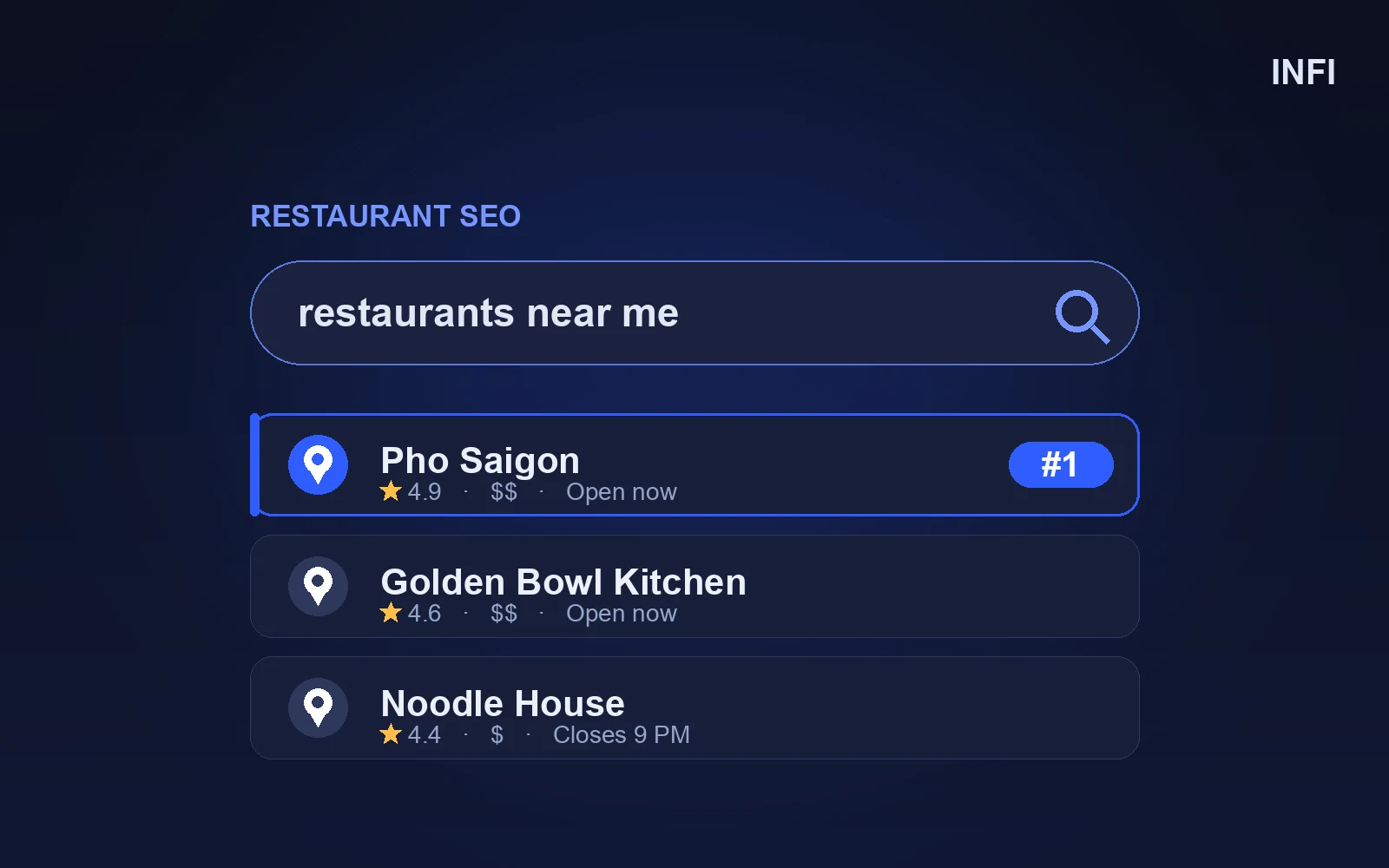
Restaurant SEO is the work of making sure that when someone near your restaurant searches for a place to eat, they find you — not the chain down the street, and not the delivery app that keeps your customer. For an independent, almost none of that is the national, blog-chasing SEO you read about. It is local: your Google Business Profile, your reviews, your website, and the handful of signals that decide who shows up in the “near me” results and the Google Maps pack.
This guide walks through what actually moves the needle in SEO for restaurants — in priority order, on any budget — and where it is worth automating. No tricks, no promise of an overnight #1 ranking. Just the things that reliably get a restaurant found, in the order they pay off.
Restaurant SEO is not about ranking for “best pasta in America.” It is about being the obvious choice the moment someone within a few miles of you is hungry and reaches for their phone. Win local, and the rest barely matters.
How local search decides who shows up
When someone searches “restaurants near me” or “tacos near me,” Google builds that result from three things: relevance (do your profile and site match what they asked for?), distance (how close are you?), and prominence (how well known and well reviewed are you?). You cannot move your restaurant, so restaurant SEO is really the work of maximizing the other two — relevance and prominence — for the searches happening around you.
That splits into three jobs, and you should work them in this order:
Google Business Profile: the highest-leverage hour you will spend
For most restaurants, the Google Business Profile — the panel on the right of a Google search and inside Google Maps — drives more visibility than the website does. It is also the fastest thing to fix. If you do nothing else from this guide, do this.
- Claim and verify the listing, and make the name, address and phone number exactly right.
- Set accurate hours — including holidays — and keep them current. Wrong hours quietly cost you orders and reviews.
- Add your menu, sharp photos of real dishes, and a direct order link that points to your own site, not a marketplace.
- Pick the most specific primary category (“Vietnamese restaurant,” not just “Restaurant”) and add relevant secondary ones.
- Post regularly — specials, new items, events. An active profile outranks a dormant one.
INFI keeps the whole profile fresh for you: menu and photos synced from your POS, weekly Google posts, and hours that stay accurate. Here is the full Google Business Profile optimization checklist.
Reviews are a ranking signal — and your replies matter more than your stars
Reviews feed directly into prominence: their quantity, quality, how recent they are, and — importantly — whether you respond. Google rewards businesses that engage, and guests read your replies more closely than they read your star average. A thoughtful reply to a middling review often does more for your reputation than the review cost you.
The hard part is consistency. Replying to every review, fast and on-brand, is exactly the task that slips when you are running a kitchen. INFI’s REACH answers every new Google review automatically, in your brand voice, around the clock — so the signal never goes cold.
Keeping a profile active and responsive compounds. One real INFI merchant saw a 252% increase in direction requests within 30 days of getting their local presence working — the “how do I get there” intent that turns into walk-ins.
Win “near me” searches: consistency and local signals
“Near me” results and the three-business map pack are where most local discovery happens now. Beyond a strong profile, two things decide whether you make the cut:
- Consistent information everywhere. Your name, address and phone number should match exactly across Google, your website, Yelp and any directory that lists you. Mismatches confuse Google and dilute your prominence.
- Local relevance on your own site. Name your city and neighborhood naturally in your page titles, headings and copy — “Thai restaurant in Tukwila,” not just “Thai restaurant” — so Google can tie you to the place people are searching from.
Our deep dive covers the rest: how to show up in “near me” searches.
Your website: fast, indexable, and built to convert
Once a searcher clicks, your site has a few seconds to earn the order. Two kinds of SEO live here — the technical hygiene that lets Google read and rank the page, and the on-page elements that turn a visit into a sale.
The technical basics that actually matter
- Speed, especially on phones. Most restaurant searches are on a phone. A slow page loses rankings and hungry guests at the same time.
- An indexable menu. If your menu is trapped in a PDF or an image, Google cannot read it. It should be real text on the page, marked up so search engines know it is a menu.
- Structured data. Restaurant, Menu and FAQ schema let Google show your hours, dishes and answers right in the results, and make you eligible for rich local listings.
- One page per location. If you have more than one spot, each needs its own indexable page with that location’s address, hours and menu — not a single shared page.
This is the layer INFI’s AI SEO handles for you: it adds Restaurant, Menu and FAQ schema, generates a page per location, and keeps your sitemap and robots files clean so Google can crawl everything.
Turn the visit into an order you keep
Ranking is wasted if the visit bounces to a delivery app. Put ordering on every page of your own site so a Google visit becomes a commission-free order you own — along with the guest’s data and the chance to bring them back. That is the difference between renting traffic and building a business.
Content and keywords: the slow, compounding part
Beyond your core pages, fresh content is what lets you rank for the long tail — “best patio dining in [your city],” “gluten-free tacos near me,” “where to get boba in [neighborhood].” Each useful page is another way to be found, and together they tell Google your site is alive.
You do not need to be a writer. INFI publishes SEO blog posts and Google posts for you from real search opportunities — each one another door in, and a steady signal that your site is active. See how it fits the bigger picture in our guide to restaurant marketing that drives orders.
Do it yourself, or let it run
- Claim and tune your Google profile, then keep it fresh every week
- Reply to every review, fast, in a consistent voice
- Keep your name, address and phone identical everywhere
- Write local content and watch your rankings
- Maintain schema, per-location pages and your sitemap
- Doable for one organized owner — until the dinner rush wins
- Profile, photos and menu kept in sync from your POS
- Every review answered automatically, 24/7, in your voice
- Schema, per-location pages and sitemap generated and maintained
- Weekly blog and Google posts from real search opportunities
- A fast site with commission-free ordering on every page
- Measured against real POS revenue, not vanity clicks
INFI runs on top of the POS you already have — Square, Toast, Clover, Lightspeed or HungerRush — so none of this means switching systems.
Your first 30 days, in priority order
- Week 1: Claim and complete your Google Business Profile — hours, categories, photos, menu, order link.
- Week 1: Reply to every review you already have, and set a rule to answer new ones within a day.
- Week 2: Make your menu real text on your site and add Restaurant and Menu schema.
- Week 2: Put a commission-free order button on every page.
- Weeks 3–4: Publish two local posts, and make your name, address and phone match everywhere.
Restaurant SEO FAQ
What is restaurant SEO?
Restaurant SEO is the practice of improving how a restaurant appears in search engines — above all in local results like “restaurants near me” and Google Maps — so nearby guests find it and order. For independents it is mostly local SEO: your Google Business Profile, reviews, a fast and indexable website, and consistent business information.
How long does restaurant SEO take to work?
Profile fixes — hours, categories, photos, review replies — can lift visibility within days to a few weeks. Website and content work such as schema, per-location pages and local content compounds over one to three months. SEO is earned rather than bought, so the gains are durable once they land.
Is SEO worth it for a small restaurant?
Yes — arguably more than for any other small business, because restaurant demand is intensely local and high-intent. Someone searching “lunch near me” is ready to order now. Being the result they see, and capturing that order on your own site, is the highest-return marketing a small restaurant can do.
How much does restaurant SEO cost?
The highest-leverage parts — your Google profile, review replies, consistent information — are free except for the time to do them consistently. The cost is exactly that consistency, which is why many operators automate it. See INFI pricing.
Restaurant SEO rewards the boring, consistent work: a complete profile, answered reviews, a fast site with a readable menu and your own order button, and steady local content. Do it by hand from this guide, or let INFI REACH run all of it on top of your current POS and prove it against real revenue. Start with the Google Business Profile checklist and showing up in “near me” searches.
See what INFI can do for your restaurant
Add self-ordering, online ordering, loyalty, and marketing on top of the POS you already run.
Book a Demo