
7 Restaurant SEO Tips to Boost Online Visibility (2026)
Boost your restaurant's online visibility with 7 proven SEO tips — keywords, mobile, local listings, Google Business Profile, content and reviews — updated for 2026.

Struggling to get more people through the door? You are not alone — the restaurant market is crowded, and a strong online presence is how you stand out. The lever is search engine optimization (SEO): the work of making your restaurant show up on Google when nearby diners look for a place to eat. It sounds technical, but the fundamentals are simple, and these seven tips cover them.
SEO is one channel in a bigger plan — see where it fits in restaurant marketing that drives orders, and for the complete local-search playbook, our restaurant SEO guide goes deeper on everything below.
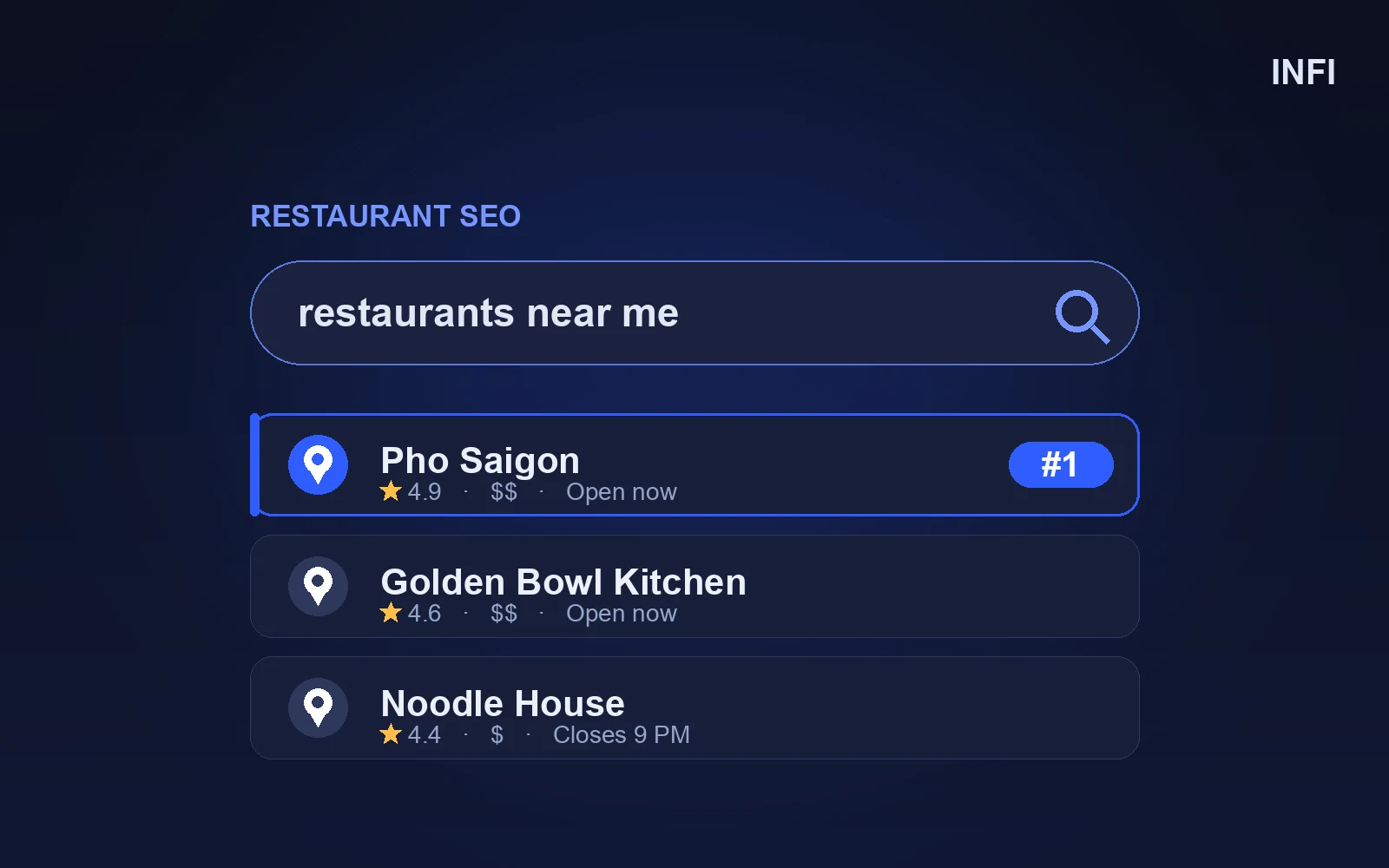
Not “rank #1 for best pasta in America.” It means being the obvious choice the moment someone within a few miles searches “near me” — and turning that click into an order.
What is SEO?
Search engine optimization is the practice of tuning your website and listings so they rank higher on Google, Bing and other search engines for the terms your customers actually type. The better optimized you are for those terms, the higher you appear — and the more traffic (and orders) you get. If you run a smoothie shop in New York, the terms to win are things like “smoothie shop NYC” and “best smoothie near me.”
Why SEO is worth it for restaurants
It takes consistency, but the payoff compounds:
- More visibility — show up at the top when diners search, instead of on page two.
- More traffic — higher rankings bring more of the right visitors to your site.
- Better experience — the same work that helps SEO (fast, clear pages) helps customers.
- Higher conversion — search traffic is high-intent, so it orders.
7 tips to help your restaurant rank
1. Define your strategy and keywords
It is easy to get lost in tools and tactics, so start with a strategy. Decide who and where you are targeting — usually the area most of your customers live, work, or visit frequently. Then research the exact terms they search, using a tool like Moz, Semrush or Google's own Keyword Planner, and group what you find into three tiers so you know what to aim at:
- High-level terms — broad searches like “restaurants in Kansas City.” High volume, high competition; worth targeting but hard to own.
- Niche terms — your category and signatures: “Mexican restaurant,” “birria tacos near me.” Lower volume, far more qualified — often your best return. Not sure which to use? See how Google, Yelp and TripAdvisor categorize places like yours.
- Brand terms — your own name. Do not assume you rank for it automatically; make sure your site outranks the directories and social profiles, because that traffic is the most valuable (and trackable) you get.
Sorting terms this way tells you what to create content around and what to measure, instead of chasing everything at once.
2. Make your website mobile-first
The large majority of restaurant searches happen on a phone, usually by someone deciding where to eat right now. If your site is slow or clumsy on mobile, you lose them before they see the menu. Fast, thumb-friendly, menu and order button up top.
3. Nail your local listings
Claim your listings across the directories that matter — Google, Yelp, TripAdvisor, Apple Maps — and keep your NAP (name, address, phone) identical everywhere. Consistent, accurate listings are the foundation of local SEO; mismatched hours or addresses quietly cost you orders and trust.
4. Perfect your Google Business Profile
Your Google Business Profile (formerly Google My Business) is the single biggest local-search lever. Claim and verify it, fill in every field — address, phone, hours including holidays, menu, categories, sharp photos — and post to it regularly. An active, complete profile is what puts you in the map pack for “near me.”
5. Get listed on the review sites
Beyond Google, directories like Yelp and TripAdvisor drive real discovery. Claim your profiles, keep them accurate, and make sure your menu and order link are current on each.
6. Publish unique, local content
Even as a single location, you need to stand out — and unique, genuinely useful content is how you do it. Google increasingly rewards context and relevance over raw keywords, so fresh content that resonates with local diners builds rankings, brand recall and trust at once.
It does not have to be essays. Share the story behind the restaurant — the founders, the culture, how a signature dish came to be and where the ingredients come from. Write up a new seasonal item, a neighborhood guide, or the answer to a question guests actually ask. And content is not just words: your menu, promotions, photos and short videos all count, and often do more to sell a table than a paragraph does. The point is to keep showing Google (and diners) that you are an active, distinctive local business rather than a generic listing. Consistency is the hard part — which is exactly why many restaurants automate the steady SEO work rather than let it lapse after a busy month.
7. Earn and answer reviews
Star ratings sit right next to your search result, and people click the high ones. Volume, a strong average, and fresh replies all help — so ask happy guests for reviews and respond to every one. (INFI's tools can reply to each new Google review automatically in your brand voice, which keeps that signal fresh without the daily chore.) With review schema in place, your rating can show in the results themselves — one more reason to click you over the place next door.
Put it on autopilot
Every tip here works by hand; the challenge is doing them every week. If you would rather the steady part ran itself — posts, review replies, listings and schema, kept current from your POS — that is what INFI's marketing tools do. Book a demo to see your search presence and what to fix first.
Hero photo by Vitaly Gariev on Unsplash.
See what INFI can do for your restaurant
Add self-ordering, online ordering, loyalty, and marketing on top of the POS you already run.
Book a Demo