
How Many Self-Ordering Kiosks Does Your Restaurant Actually Need?
How many kiosks per restaurant? A volume-and-format sizing guide: the rule of thumb, the peak-hour math, and where to place them for real throughput.
The honest answer to "how many self-ordering kiosks does my restaurant need?" is: it depends on your peak, not your average. Most operators over-index on square footage or copy whatever the location down the street installed. What actually determines the right number is how many orders you have to process in your busiest 60 minutes — and how quickly a single kiosk can turn one guest into a completed, paid order.
This guide gives you a defensible starting number, the math to pressure-test it, and the format-specific adjustments that separate a smooth lunch rush from a line out the door.
The quick rule of thumb
If you want a number before you finish reading: plan for roughly one kiosk per 40–60 covers at peak, then round up. A small quick-service shop doing 200 covers a day usually lands at 2 kiosks. A busy fast-casual concept pushing 600–800 daily transactions typically needs 3–5. A stadium concession stand or high-volume food hall can justify 6 or more per outlet.
That rule is a starting point, not a verdict. Two restaurants with identical cover counts can need very different hardware if one sells $6 coffees in 30 seconds and the other builds $22 customized bowls. Use the rule to get in the neighborhood, then do the math below.
The peak-hour math that actually sizes it
Kiosks are a throughput problem, and throughput is easy to model. You need three numbers:
- Peak-hour orders — how many orders you take in your single busiest hour, not your daily total.
- Average order time at the kiosk — browsing, customizing, upselling, and paying. For most menus this runs 60–120 seconds; deep customization pushes it higher.
- Acceptable wait — how long a guest will stand in a virtual queue before they balk. Two to three people deep is usually the ceiling before walk-offs start.
A single kiosk realistically completes 30–50 orders per hour once you account for real-world browsing and the occasional slow decision. Divide your peak-hour orders by that number and round up:
Kiosks needed = peak-hour orders ÷ 40 — then round up, and add one for redundancy.
So a lunch rush of 120 orders in the peak hour works out to roughly 3 kiosks (120 ÷ 40 = 3), plus one spare so a paper jam or a reboot never takes you to zero. That redundancy unit is the step operators most often skip — and the one they regret first.
A sizing guide by volume
Here is the rule of thumb and the math combined into a quick reference. Treat these as ranges, not guarantees — your menu complexity moves the needle.
- Under 200 transactions/day (café, small QSR): 1–2 kiosks.
- 200–500/day (fast casual, single line): 2–3 kiosks.
- 500–900/day (high-volume fast casual): 3–5 kiosks.
- 900+/day (food hall, stadium, multi-station): 5 or more per outlet.
Format changes the answer
Volume tells you the baseline; format tells you how to adjust it. A few patterns hold up across formats:
- Coffee and grab-and-go — short order times mean each kiosk clears more guests per hour, so you can run leaner. Placement matters more than count.
- Build-your-own bowls, burritos, pizza — long customization times slow each kiosk down. Add one beyond what the raw volume suggests.
- Food halls and stadiums — demand is spiky and unforgiving. Size to the surge (halftime, the lunch bell), not the daily average, or you will be underwater exactly when it counts.
- Drive-thru and curbside heavy — much of your volume never touches an in-store kiosk. Offload it to commission-free online ordering and a branded app before you buy another terminal.
Do not forget the offload
The cheapest kiosk is the one you do not have to buy because the order came in through another channel. Every order placed on your website or app is one fewer body in the in-store queue, which means your kiosk count is really a function of walk-in peak, not total peak.
This is why we treat kiosks as one channel in a system rather than a standalone box. When online, app, and loyalty pull a meaningful share of orders ahead of time, the in-store hardware you need drops — often by a full unit or two at busy sites.
Placement beats count
Two well-placed kiosks outperform four badly placed ones. A few rules that consistently hold:
- Put kiosks before the natural bottleneck (the counter), so ordering happens while guests would otherwise be waiting.
- Leave space for a queue to form without blocking the entrance or the pickup area.
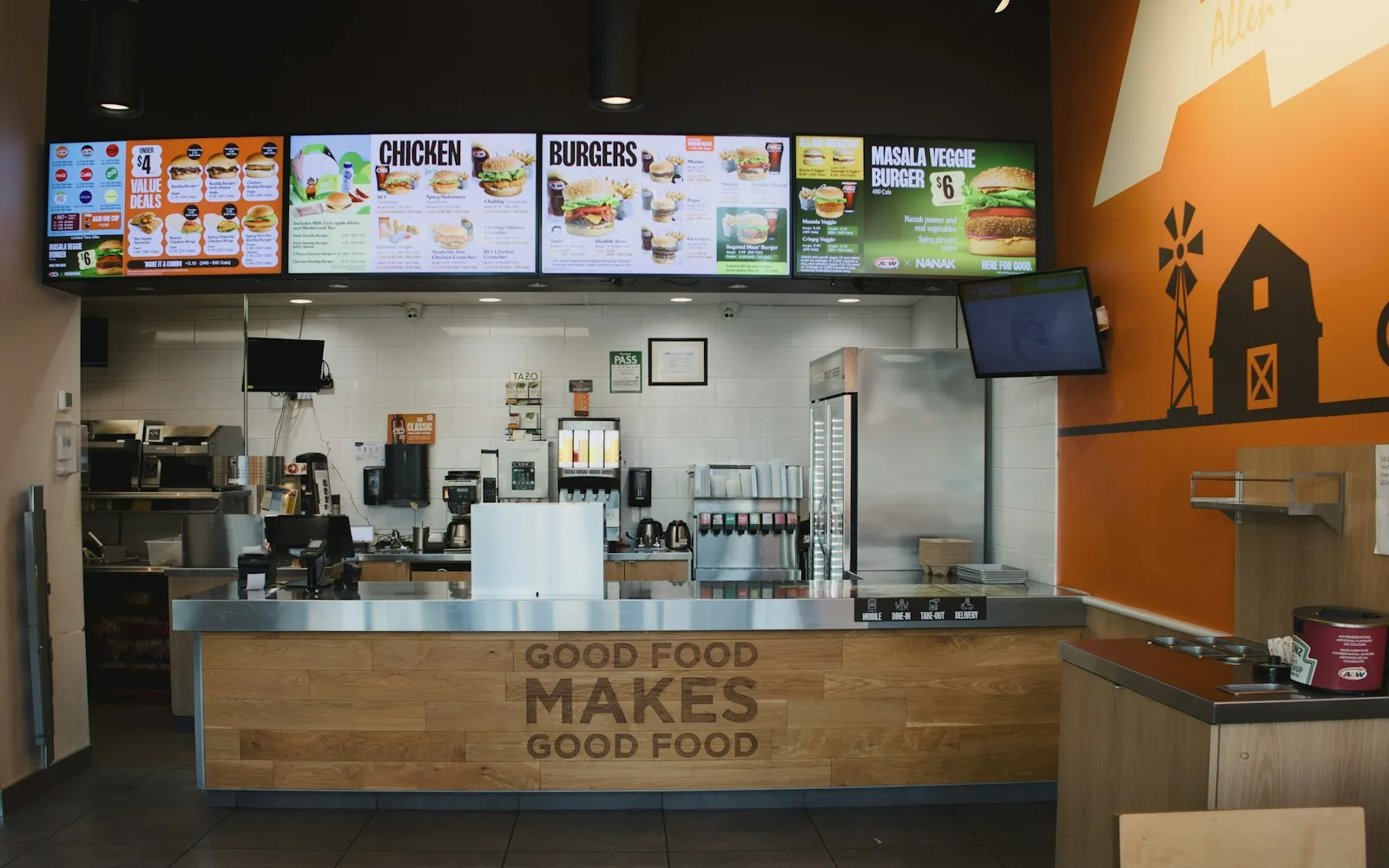
- Pair kiosks with clear digital menu boards and customer displays so order status is visible and the line keeps moving.
- Keep at least one accessible, seated-height terminal for ADA compliance.
What kiosks are actually worth
The reason to get the count right is that kiosks pay for themselves through larger orders, not just faster lines. Self-ordering typically lifts average order value by 15–30% because the screen never forgets to upsell and never rushes an indecisive guest.
On INFI, that pattern shows up in our merchants' numbers: PJ's Coffee saw a 45% lift in average order value, Juice Press +15% per order, and Oak View Group venues doubled basket size. Size your fleet too small and you leave that lift on the table during your most valuable hours.
How INFI helps you get it right
INFI is the Restaurant Growth Platform — your POS runs the register, INFI runs your growth. Our self-ordering kiosks layer on top of the POS you already run (Square, Toast, Clover, Lightspeed, HungerRush), so you are not ripping anything out to add capacity. Because kiosks, online ordering, app, loyalty, and displays live on one platform, we can size your in-store hardware against your real walk-in peak instead of your total volume — and deploy it without guesswork. With 1,800+ restaurants live and a team led by a former restaurant operator, we can help you get the number right the first time.
Not sure whether you need two kiosks or five? Tell us your peak-hour numbers and format, and we will model it with you. Book a Demo — or reach the team at 888-857-9831.
See what INFI can do for your restaurant
Add self-ordering, online ordering, loyalty, and marketing on top of the POS you already run.
Book a Demo